
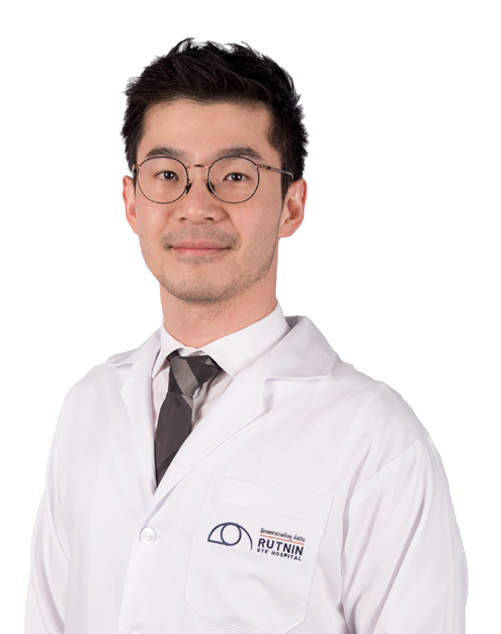
Dr. Supanut Apinyawasisuk, M.D. – Neuro-Ophthalmology Specialist
Dr. Supanut Apinyawasisuk is a neuro-ophthalmology specialist at Rutnin Eye Hospital, Bangkok, trained at Chulalongkorn, Chiang Mai, Ramathibodi and the Stein and Doheny Eye Institute (UCLA). Dr. Supanut has published widely on optic nerve disease and myasthenia gravis.
| Field | Details |
| Specialty | Neuro-Ophthalmology, Cataract, General Ophthalmology |
| Hospital | Rutnin Eye Hospital, Sukhumvit 21 Road (Asoke), Bangkok |
| Medical licence | ว.36569 (Medical Council of Thailand) |
| Consultation days in Bangkok | Confirm with Bangladesh Office |
| Languages | English, Thai |
| Booking from Bangladesh | Call or WhatsApp +880 1744418805 |
About Dr. Supanut Apinyawasisuk
Dr. Supanut Apinyawasisuk is an ophthalmologist at Rutnin Eye Hospital whose practice centres on neuro-ophthalmology: eye and vision problems that come from the optic nerve, the brain or the nerves and muscles that move the eyes and eyelids. Dr. Supanut also sees patients with cataract and general eye problems.
Dr. Supanut earned a medical degree with honours from the Faculty of Medicine, Chulalongkorn University, in 2008, then completed residency training in ophthalmology at Chiang Mai University (2009–2013), receiving the Diploma in Ophthalmology in 2013. Neuro-ophthalmology training followed at Ramathibodi Hospital, Mahidol University (2014), and an international fellowship in neuro-ophthalmology at the Stein and Doheny Eye Institute, University of California, Los Angeles (2015–2016).
Research is a large part of Dr. Supanut’s work. Dr. Supanut’s papers cover ocular myasthenia gravis, Leber hereditary optic neuropathy, optic neuritis (including syphilitic and MOG antibody-associated cases), benign essential blepharospasm and its treatment with botulinum toxin, and OCT angiography of the optic nerve. They appear in journals including the American Journal of Ophthalmology, the Journal of Neuro-Ophthalmology and PLoS One.
Conditions & treatments
Conditions treated
- Optic neuritis and other optic nerve disorders
- Hereditary optic neuropathy, including Leber hereditary optic neuropathy (LHON)
- Ocular myasthenia gravis (droopy eyelids and double vision that vary during the day)
- Double vision and eye-movement problems linked to nerve disorders
- Benign essential blepharospasm (involuntary eyelid closure)
- Cataract
Procedures performed
- Neuro-ophthalmic examination, including eyelid tests for myasthenia gravis
- Optic nerve imaging with OCT and OCT angiography
- Botulinum toxin injection for blepharospasm
- Cataract surgery
Education & training
Medical degree
- Doctor of Medicine (Honours), Faculty of Medicine, Chulalongkorn University (2008)
Residency & board certification
- Residency in Ophthalmology, Chiang Mai University (2009–2013)
- Diploma in Ophthalmology, Chiang Mai University (2013)
Fellowship training
- Neuro-Ophthalmology, Ramathibodi Hospital, Mahidol University (2014)
- International Fellowship in Neuro-Ophthalmology, Stein and Doheny Eye Institute, University of California, Los Angeles (UCLA), USA (2015–2016)
Publications & academic work
Selected peer-reviewed publications
- Disagreement of radial peripapillary capillary density among four optical coherence tomography angiography devices. Translational Vision Science & Technology 2023;12(8):7. PMID 37555736.
- Health-related quality of life of daily-life-affected benign essential blepharospasm: a multi-center observational study. PLoS One 2023;18(3):e0283111. PMID 36920965.
- Changes in ocular biomarkers from normal cognitive aging to Alzheimer’s disease: a pilot study. Eye and Brain 2023;15:15–23. PMID 36891125.
- Epidemiology and mutation types of Leber hereditary optic neuropathy in Thailand. Annals of Medicine 2022;54(1):1601–1607. PMID 35723074.
- Interobserver and intra-observer reliability of eyelid tests for ocular myasthenia gravis. Journal of Neuro-Ophthalmology 2022;42(2):230–233. PMID 34860746.
- MOG antibody-associated optic neuritis with COVID-19 infection: case report and literature review. American Journal of Ophthalmology Case Reports 2022;26:101491. PMID 35313470.
- Complications of preseptal versus pretarsal botulinum toxin injection for benign essential blepharospasm (randomised controlled trial). American Journal of Ophthalmology 2021;232:9–16. PMID 33965414.
- Apinyawasisuk S, Chongpison Y, Thitisaksakul C, Jariyakosol S. Factors affecting generalization of ocular myasthenia gravis in patients with positive acetylcholine receptor antibody. American Journal of Ophthalmology 2020;209:10–17. PMID 31562855.
…and 8 further publications listed on the hospital profile, including work on the forced eyelid closure test, optic disc melanocytoma, Leber hereditary optic neuropathy after trauma, syphilitic optic neuritis and retinal vasculitis in Northern Thailand.
For patients from Bangladesh
Our Dhaka office books your appointment with Dr. Supanut Apinyawasisuk at Rutnin Eye Hospital, Bangkok, and supports you before, during and after your trip.
How to book
- Send your name, WhatsApp number and a short description of your eye problem.
- Share photos or scans of your recent eye reports. We pass them to Rutnin so your case is matched to the right doctor.
- We confirm a date on one of Dr. Supanut’s consultation days and help with your visa letter, flights and hotel.
- A Bengali-speaking coordinator stays in touch with you in Bangkok and after you return home.
What to bring to your consultation
- Past eye prescriptions and your spectacle power
- Eye test reports, such as visual field tests, optic nerve OCT scans, and any brain or orbit MRI/CT reports
- Blood test results and letters from your neurologist, if you have them (for example, antibody tests for myasthenia gravis)
- A list of the eye drops and other medicines you currently use
- Your passport and appointment confirmation
If you wear contact lenses, ask the office before you travel: some corneal and refractive assessments require you to stop wearing lenses for a period beforehand.
This profile is for general information. Diagnosis and treatment decisions are made by the doctor after a full examination at Rutnin Eye Hospital.
Frequently asked questions
What does a neuro-ophthalmologist treat?
Neuro-ophthalmology covers vision problems that come from the optic nerve, the brain or the nerves controlling eye and eyelid movement, such as optic neuritis, double vision and droopy eyelids. Dr. Supanut completed neuro-ophthalmology training at Ramathibodi Hospital and an international fellowship at the Stein and Doheny Eye Institute, UCLA.
I have droopy eyelids and double vision. Could it be ocular myasthenia gravis?
It can be one possible cause, among others. Dr. Supanut has published research on eyelid tests used to screen for ocular myasthenia gravis and on the factors that predict when it spreads beyond the eyes. A diagnosis can be made only after examination and, often, further tests.
Does Dr. Supanut treat blepharospasm?
Yes. Dr. Supanut has published a randomised trial comparing botulinum toxin injection sites for benign essential blepharospasm, and a multi-centre study of its effect on quality of life. The right treatment is decided after a full examination.
On which days does Dr. Supanut see patients?
Please contact the Bangladesh Office for Dr. Supanut’s current consultation days. They will confirm an available date before you book travel.
Can I send my reports before travelling to Bangkok?
Yes. Send your reports, including any MRI or CT scans, to the Bangladesh Office on WhatsApp, and they will arrange for them to be shared with the hospital before your visit.